Wednesday, January 13, 2010
ANDALUCÍA
This is an ad. Cruzcampo, the typical Andalusian beer, wanted to pay tribute to the land of Andalusia and its people. The campaign tries to gloss over in seconds and features the most representative values of Andalusia and Andalusia and convey a message of pride, optimism and warmth. We like it, so...here it is.
Thursday, January 7, 2010
News from Norway

Problems caused by low temperatures.
The weather has been really cold in Norway this week (below -40 Celcius in the inland valleys and -20 in Oslo) and it has caused several problems: bus transport has been affected and private drivers also have problems to start their cars. Streets in downtown Oslo have been flooded twice in the past few days.
The Norway Post (Online newspaper). Friday, 7th January, 2010.
http://www.norwaypost.no/content/view/23014/26/
Francisca P.
Monday, January 4, 2010
Last post about Christmas


NAVIDAD EN ESPAÑA
The begining of Christmas can be considerate on December 22, with the Christmas Lottery. This draw is the most important in the country.
EL BELÉN
One of the main traditions is the Nativity scene, a miniature representation of the birth of Christ, the shepherds, the three wise men etc.. It is a Christmas decoration into homes, but can become a work of art.
NOCHEBUENA
The tradition of Christmas Eve Night is familiar. In fact, until recently, bars and restaurants did not open that night.It is usually a family dinner, with a varied menu, but the most normal dishes are seafood and turkey. Some towns and regions have also other typical dishes that night. At twelve o'clock at night, catholics attend "La misa del Gallo" .
EL AGUINALDO
Children sing carols and ask for the aguinaldo (candy, some coins ...). This tradition has disapppeared in cities but it continues in villages.
On the 28th of December is "El día de los Inocentes", this day it is permitted to play jokes on people.
NOCHEVIEJA
Almost all families follow the end of the year through television with the last 12 strokes of midnight in the Puerta del Sol in Madrid, while they have to eat a lucky grape with each stroke.
LOS REYES MAGOS
The night of January 5 is the best moment for children, when the Three Wise Men, who travel on their three camels, arrive. They come in procession through the streets of towns and they throw candies and sweets. After this, the children have to go to bed early because, if they have behaved well, the Wise Men will bring everything they have asked for.
According to tradition, The Three Wise men, called Melchor, Gaspar and Baltasar, who represent Europe Asia and África respectively, brought to baby Jesus Christ, gold, incense and myrrh.
ROSCÓN DE REYES
The day after the night of the Wise Men, it is a tradition to eat "el roscón de reyes", a cake that have inside diferent surprises.
Diego G.
Monday, December 21, 2009
Christmas in Spain
Christmas in Spain is celebrated following the catholic customs. These days are very familiar in Spain, we gather in several occasions during Christmas. One of the most important days to spend with the family are Christmas Eve and Christmas Day. We celebrate days in the same way than in most countries, the only difference is that people don’t usually have turkey for dinner. On New Year's Eve we have dinner with friends or family and then, at twelve o’clock we eat 12 grapes, one with every chime.
On the 5th of January all children expect impatiently for the arrival of the ‘Three Wise Men’’. This day there is a parade on the streets and the Three Wise Men go in their floats throwing sweets to the children.
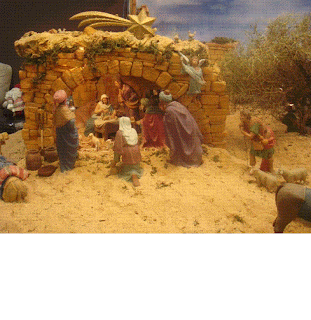
Another important difference of how Spanish people celebrate Christmas is the way we decorate our home. Apart from the Christmas tree we also set the crib.
Laura V.
On the 5th of January all children expect impatiently for the arrival of the ‘Three Wise Men’’. This day there is a parade on the streets and the Three Wise Men go in their floats throwing sweets to the children.

Another important difference of how Spanish people celebrate Christmas is the way we decorate our home. Apart from the Christmas tree we also set the crib.
Laura V.
Draw Lotery Christmas


On December 22, Draw Lottery Christmas:
The festivities begin on December 22, the day the Christmas holidays begin in schools, and also is an important day because it celebrates the Lottery Draw Christmas. This lottery, the largest in Spain, is a tradition practiced by many people, who is hoping to win millions of euros. Since 1763, under the reign of Charles III has managed to do this lottery draw, without missing even a year. Let's say that's the starting gun for Christmas.
Verónica J.
Christmas in Spain
On 22nd December, Draw Christmas Lottery
The festivities begin on December 22, this day begins the Christmas holidays in institutes and schools, and it’s an important day because we celebrate the Lottery Draw Christmas. This lottery, the largest in Spain, it’s a tradition practiced by many people, who hope to win millions of Euros. Since 1763, under the reign of Charles III, this lottery draw had been done without missing even a year. It is the beginning of Christmas.
On 24th December, Christmas Eve
In Spain, as in many parts of the world, a tradition practiced very typical of this day; make a special dinner with the family. There are a wide variety of typical foods eaten that day and other holidays of Christmas and of course that in each region different dishes prepared. To drink, take a glass of cava, Spanish wine like French champagne.
On 25th December, the Christmas Day
On Christmas Day is often also a family meal.
On 28th December, the Day of the Innocents
On 28th December is a holiday in Spain, is the Day of the Innocents. This festival has its roots in a very bloody event, but nowadays the custom is to make a joke to friends or family to laugh and play with people. On this day, many people get confused because the papers publish news absurd or incredible, but everyone accepts the banter.
On 31st December, New Year's Eve
Of course, the celebrations of 31 December or New Year's Eve in Spain is a spectacular sight. In all the squares of Spanish cities, you can see a similar scene, and the protagonists are grapes and bells. When the clock strikes 12, the bells ring 12 times; all Spanish eat 12 grapes, one for each toll of the bell. According to tradition, those who eat the grapes will have 12 months of prosperity during the coming year. Family and friends stay together for this celebration marking the end of one year and the beginning of another, and in the case of the Spanish, is very common to hold the party until the wee hours of the morning.
Pablo F.
The festivities begin on December 22, this day begins the Christmas holidays in institutes and schools, and it’s an important day because we celebrate the Lottery Draw Christmas. This lottery, the largest in Spain, it’s a tradition practiced by many people, who hope to win millions of Euros. Since 1763, under the reign of Charles III, this lottery draw had been done without missing even a year. It is the beginning of Christmas.
On 24th December, Christmas Eve
In Spain, as in many parts of the world, a tradition practiced very typical of this day; make a special dinner with the family. There are a wide variety of typical foods eaten that day and other holidays of Christmas and of course that in each region different dishes prepared. To drink, take a glass of cava, Spanish wine like French champagne.
On 25th December, the Christmas Day
On Christmas Day is often also a family meal.
On 28th December, the Day of the Innocents
On 28th December is a holiday in Spain, is the Day of the Innocents. This festival has its roots in a very bloody event, but nowadays the custom is to make a joke to friends or family to laugh and play with people. On this day, many people get confused because the papers publish news absurd or incredible, but everyone accepts the banter.
On 31st December, New Year's Eve
Of course, the celebrations of 31 December or New Year's Eve in Spain is a spectacular sight. In all the squares of Spanish cities, you can see a similar scene, and the protagonists are grapes and bells. When the clock strikes 12, the bells ring 12 times; all Spanish eat 12 grapes, one for each toll of the bell. According to tradition, those who eat the grapes will have 12 months of prosperity during the coming year. Family and friends stay together for this celebration marking the end of one year and the beginning of another, and in the case of the Spanish, is very common to hold the party until the wee hours of the morning.
Pablo F.
Monday, December 7, 2009

The day´s of Inmaculada, my father, my brother and I go to Sierra Nevada. It´s our favourite place because we love skiing.Then, my family and I go to my village, Güejar Sierra, to have dinner with my grandparents, my cousins and my uncles.
El día de la Inmaculada, mi padre, mi hermano y yo vamos a Sierra Nevada. Es nuestro lugar favorito porque nos encanta esquiar. Después, mi familia y yo vamos a mi pueblo, Güéjar Sierra, para cenar con mis abuelos, mis primos y mis tíos.
Victor C.
Subscribe to:
Posts (Atom)