Monday, December 21, 2009

Christmas in Spain

Christmas in Spain is celebrated following the catholic customs. These days are very familiar in Spain, we gather in several occasions during Christmas. One of the most important days to spend with the family are Christmas Eve and Christmas Day. We celebrate days in the same way than in most countries, the only difference is that people don’t usually have turkey for dinner. On New Year's Eve we have dinner with friends or family and then, at twelve o’clock we eat 12 grapes, one with every chime.

On the 5th of January all children expect impatiently for the arrival of the ‘Three Wise Men’’. This day there is a parade on the streets and the Three Wise Men go in their floats throwing sweets to the children.


Another important difference of how Spanish people celebrate Christmas is the way we decorate our home. Apart from the Christmas tree we also set the crib.

Laura V.

Draw Lotery Christmas


On December 22, Draw Lottery Christmas:
The festivities begin on December 22, the day the Christmas holidays begin in schools, and also is an important day because it celebrates the Lottery Draw Christmas. This lottery, the largest in Spain, is a tradition practiced by many people, who is hoping to win millions of euros. Since 1763, under the reign of Charles III has managed to do this lottery draw, without missing even a year. Let's say that's the starting gun for Christmas.
Verónica J.

Christmas in Spain

On 22nd December, Draw Christmas Lottery
The festivities begin on December 22, this day begins the Christmas holidays in institutes and schools, and it’s an important day because we celebrate the Lottery Draw Christmas. This lottery, the largest in Spain, it’s a tradition practiced by many people, who hope to win millions of Euros. Since 1763, under the reign of Charles III, this lottery draw had been done without missing even a year. It is the beginning of Christmas.

On 24th December, Christmas Eve
In Spain, as in many parts of the world, a tradition practiced very typical of this day; make a special dinner with the family. There are a wide variety of typical foods eaten that day and other holidays of Christmas and of course that in each region different dishes prepared. To drink, take a glass of cava, Spanish wine like French champagne.

On 25th December, the Christmas Day
On Christmas Day is often also a family meal.
On 28th December, the Day of the Innocents
On 28th December is a holiday in Spain, is the Day of the Innocents. This festival has its roots in a very bloody event, but nowadays the custom is to make a joke to friends or family to laugh and play with people. On this day, many people get confused because the papers publish news absurd or incredible, but everyone accepts the banter.

On 31st December, New Year's Eve
Of course, the celebrations of 31 December or New Year's Eve in Spain is a spectacular sight. In all the squares of Spanish cities, you can see a similar scene, and the protagonists are grapes and bells. When the clock strikes 12, the bells ring 12 times; all Spanish eat 12 grapes, one for each toll of the bell. According to tradition, those who eat the grapes will have 12 months of prosperity during the coming year. Family and friends stay together for this celebration marking the end of one year and the beginning of another, and in the case of the Spanish, is very common to hold the party until the wee hours of the morning.

Pablo F.

Monday, December 7, 2009


The day´s of Inmaculada, my father, my brother and I go to Sierra Nevada. It´s our favourite place because we love skiing.Then, my family and I go to my village, Güejar Sierra, to have dinner with my grandparents, my cousins and my uncles.

El día de la Inmaculada, mi padre, mi hermano y yo vamos a Sierra Nevada. Es nuestro lugar favorito porque nos encanta esquiar. Después, mi familia y yo vamos a mi pueblo, Güéjar Sierra, para cenar con mis abuelos, mis primos y mis tíos.
Victor C.

Catedral de Granada ( Español): La Santa Iglesia Catedral Metropolitana de la Encarnación de Granada es un templo católico de la ciudad española de Granada, sede de la archidiócesis de la ciudad. El templo es una de las obras cumbres del renacimiento español. Por ella pasan todas las hermandades de la Semana Santa granadina durante sus respectivas estaciones de penitencia ante el Santísimo Sacramento.


Granada`s cathedral ( English): The holy church, metropolitan cathedral of the " Encarnacion" of Granada is a catholic temple of the spanish city of Granada, main point of the "archidiósis" of the city. The temple is one of the best spanish renaissance. All the brotherhoods pass through it when its the granada`s holy week during the penance season.
Laura S.

Tuesday, December 1, 2009

Spanish Festivals


The day of the Immaculate Conception is a national holiday and it is celebrated because the Immaculate Concepcion is the patron saint of Spain from 1761. The Immaculate Conception is an article about faith of the Catholicism that supports the belief in which Maria, Jesus's mother was not reached by the original sin but, from the first moment of his conception it was free of any sin. The belief in the Immaculade Concepcion took root especially in Spain. Numerous temples, chapels and monuments were dedicated to her, and she was nominated a patron saint of the kingdom by Carlos III. The doctrine was defined definitely as a faith dogma on December 8, 1854, for pope Pío IX. Since then December 8 has stayed like date of the holiday of the Immaculade Concepcion in the whole Catholic Church. In the day of the Immaculate Conception a mass is celebrated and the Spanish priests can take a blue chasuble. In some places also processions are celebrated

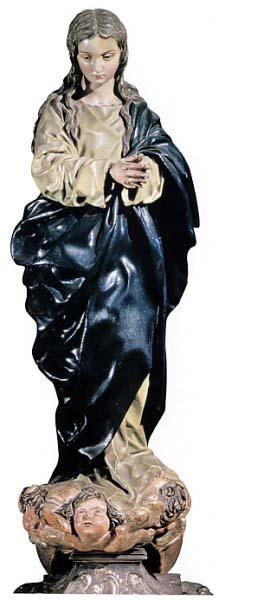
This is a sculpture of the Immaculate Conception and it is in the cathedral of Granada. It was made by Alonso Cano.

Manuel L.

Fiesta de la Inmaculada Concepción


Fiesta de la Inmaculada Concepción

El 8 de diciembre vuelve a ser fiesta nacional en toda España, justo dos días después de la fiesta de la Constitución, por lo que se trata de uno de los “puentes” (unión de varios días de fiestas seguidos) más esperados por todos los españoles antes de que llegue la navidad.
El dogma de la Inmaculada Concepción es un artículo de la fe católica que sostiene la creencia de que María, madre de Jesús, a diferencia del resto de seres humanos, no fue alcanzada por el pecado original, sino que, desde el primer instante de la creación de su alma, estuvo libre de todo pecado. Esta doctrina no es aceptada ni por los cristianos ortodoxos ni por los protestantes.
Es evidente que España es un país marcado por la religión católica y muchas de sus festividades conllevan un fuerte carácter religioso. No obstante, y a pesar de que las iglesias celebran diversos actos en estas fechas, la mayoría de los españoles aprovechan este puente para irse a su segunda residencia, hacer deportes de nieve y montaña o visitar algún otro país extranjero.
PABLO F.